8/25/18

Reese Kaplan -- Since the Mets Don't Care About Defense...


While everyone gets on Sandy Alderson for the contracts handed out this past off-season to Jason Vargas, Anthony Swarzak and Jay Bruce which resulted in poor production, somehow no one seems nearly as upset by Todd Frazier’s minimal contributions.  Yes, he’s had some injuries and if you extrapolated his numbers they wouldn’t be awful.  In fact, hitting in the .230s is a step above what he delivered for the White Sox and Yankees last season.  At $8 million this year, he took a cut from the $12 million he was earning.  Next year he’s on tap for $9 million and performing at 2 WAR you could certainly argue he’s good value.


In roughly the same amount of ABs Wilmer Flores has provided the same offense with a higher batting average.  More importantly, he’s showing that with regular playing time those number have improved dramatically – something we’ve seen the past as well.  Wilmer is earning $3.4 million this year and arbitration eligible for the first time.  At 1.3 WAR, he’s going to get a pretty big bump in pay.  By numbers he is rated as a -2 defensively (slightly below average) at 1B though the eyeball test may disagree.  He is someone Manager Mickey Callaway has singled out as needing to be in there every day because he takes quality ABs.

Therein lies the problem.  The Mets’ highest rated near term prospect is Pete Alonso who plays 1st base.  Then there’s Jay Bruce having worked out at 1B.  Then there’s Dom Smith whose best position is 1st base.

Well, what about 2nd?  Jeff McNeil is certainly making the case that the Mets should have promoted him the second Todd Frazier went down with an injury, but hey, we all know how critical it was to get Jose Reyes and Jose Bautista more playing time, right?

So, going into 2019 you have an interesting problem.  Assume they hold Pete Alonso down for the first 3-4 weeks of the season “to work on his defense” – at least that’s what the Cubbies got the Players’ Union to swallow when they didn’t promote Kris Bryant to start the year.  Who plays 1st for that interval doesn’t much matter.  However, once Alonso arrives (miraculously having dramatically improved his defense in just 3-4 weeks), who goes where?


Just to add gasoline to the fire, there are a number of folks campaigning for the Mets to reunite with hands-of-stone Daniel Murphy because he can hit the ball well.  Wait…isn’t that the very same profile of Wilmer Flores – someone who can hit but doesn’t seem to comport himself well while wearing a leather on his hand?  To wit, Murphy ranged from -7 to -9 as a second baseman while playing for the Mets.  Will he improve with age?  He’d be 34 next season.  By contrast Wilmer Flores was nearly as lethal at 3B but at worst was a -3 at 2B. 

Many feel Wilmer’s best role (should he stay with the Mets) is as a supersub, getting ABs all around the diamond and coming off the bench.  Evidence has shown that he performs better when playing steadily.  Unlike others, he does not get “exposed” when he’s in the lineup on a daily basis. 
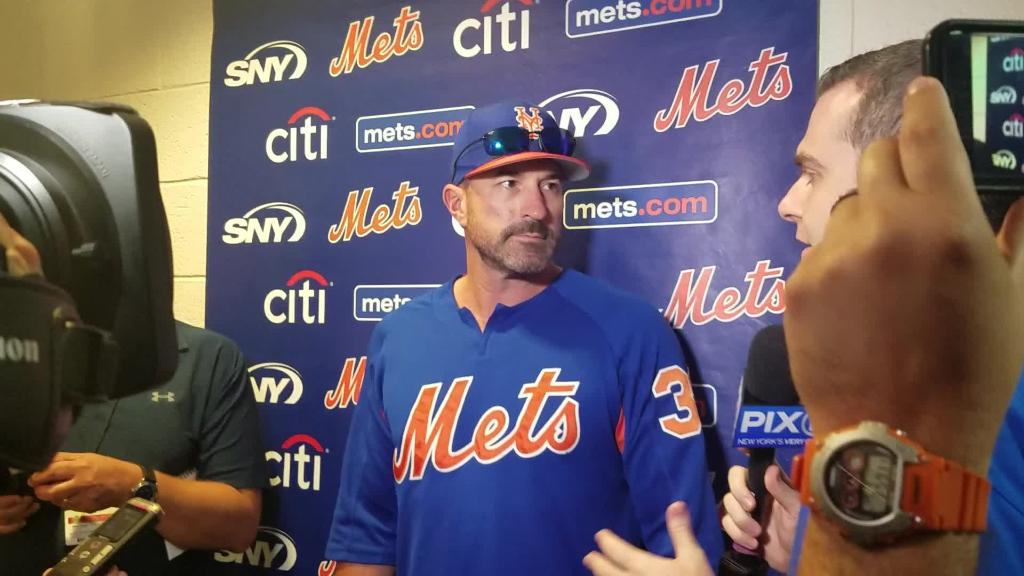

On Thursday I read the disheartening comment from a clearly flummoxed Terry II that perhaps they’re going to move McNeil around to see how he responds to a utility role.  WHAT???????????????

No, the answer seems obvious to me from both an economic standpoint and run production standpoint.  Once Alonso arrives, play Wilmer at 2B and shift McNeil to 3B.  While Todd Frazier still has not gotten the stink of failure on him that plagues many Mets’ acquisitions, peddle him and his reasonable contract to another club.  You’re only secure with him for one more year anyway, and better to trade someone a year too soon than a year too late.  Take the savings delta between his salary and Flores’ salary to address another need.  If Alonso struggles against certain righties, you still have Bruce (and Smith) available to play 1B.  You’re not going to find takers for Sandy’s mistakes (throw Juan Lagares in that mix, too), so you’d better start thinking about small savings wherever you can find them. 

8/24/18

Tom Brennan: BASEBALL RULES I'D LIKE TO SEE CHANGED

Tom Brennan: BASEBALL RULES I'D LIKE TO SEE CHANGED

Baseball is a game designed with genius, and has many rules established to make it a lasting and cherished game to millions.

Some rule changes could make it better, in my opinion.  Here are mine:

1) 40 MAN ROSTER RULE SHOULD BE CHANGED

Jack Reinheimer gets called up, Peter Alonso does not...which of course makes no sense at all, talent-and-performance-wise.  Peter has over 30 homers and leads all of baseball, majors and minors, in RBIs.
We hear that Peter won't be added to the team in September because he'd have to be added to the 40 man roster.  I say he is being discriminated against.  

I say, why not suspend the 40 man roster rule as it pertains to September call ups, allowing a team to increase its September roster to a maximum of, let's say, 35.  That would allow Peter to be called up. 

That would allow a player like Patrick Kivelhan to be called up, too.

Kivlehan gets no ink here, or elsewhere, because he is not on the 40 man roster and is unlikely to be added to it.  Yet, the 28 year old has had 199 major league at bats in 2016 and 2017, hitting just .203, but with 10 homers and 28 RBIs. 
 
In his last 10 AAA games, he is 15 for 38 with 7 homers and 15 RBIs.  Wouldn't it be nice if a guy like this, hitting .304 in 87 games for Las Vegas, could get called up and get another chance to show he is more than a journeyman in September?

Oh, but Peter Alonso would not be called up anyway because that would "start his clock."  So...

2) PLAYER CLOCK RULES SHOULD BE CHANGED

If an Alonso is called up in September, change the rule that it will NOT affect his time on the so-called "clock".  It is another arbitrary hindrance.  

What do you think, if someone went to Alonso and said, "buddy, you have a choice...we can not change the "40 man and clock" rules and leave you in the minors, or change them (as Tom Brennan suggests) and have you come up for September". 

What choice do you think he, or anyone in his shoes, would happily make?

I know the fans would love to see him, fully ready or not.


3) YEARS TO FREE AGENCY RULE

Pitchers like Matt Harvey or Jake deGrom play Russian Roulette every time they pitch - will they stay healthy, or have a career-damaging injury on their next pitch?  

I would advocate that pitchers get to free agency a year earlier for that reason.  Hitters can get hurt too but not, in most cases, as suddenly and impactfully and catastrophically as a pitcher can. 

So I would shorten pitchers up to free agency by a year.

Hurts the teams somewhat, but it is the right thing to do for them.  Jake makes nowhere near as much as his peer, Max Scherzer, because of these rules.  Change it.


4) INCREASE ROSTER TO 26 PLAYERS

Back when I was a teenager in the 1960's, teams had 10 pitchers and 15 position players.  Now, it's 12 and 13.  That's 2 less position players, if 15 minus 13 is tough to calculate in your head - just here to help.

So, hitters like a Kivlehan or a Luis Guillorme get relatively less opportunity to make teams for any meaningful amount of playing time than in days gone by.  One more player on each team would drastically increase a team's in-game versatility. 

For instance, you want to carry 3 catchers?  Go ahead.  I think it would add to the game.


5) DITCH THE SHIFT

Jay Bruce moaned earlier this year about it being a fact that with the shift, almost any hard hit ball to the right side not in the air is an out for him.  Some say, "learn to hit to all fields like a Jeff McNeil then."  

Good for Jeff, not good for a Jay Bruce. I say the shift's thievery robs guys of their strengths - I don't want a Jay Bruce to have to alter his power game just to try to thwart a shift.

Make it so that when Jay is up, the shortstop must remain left of 2nd base until the pitch has reached the hitter.  And when a righty is up, no 3 man shifts on the left side.

I'll bet that will boost teams' major league averages by 10-15 points.  Right now, no team is hitting .270, and only 2 above .260.  That's 2 out of 30 teams above .260.  That stinks. 

Change the rule.

What do you think?  

Do you agree?  

Any others you would want changed?


Tom Brennan - METS' SOFT TOSSERS - SUCCESSES AND FAILURES

(pictured above: Randy Jones)

Tom Brennan - METS' SOFT TOSSERS - SUCCESSES AND FAILURES

Once upon a time, a soft-tossing sinkerballer named Randy Jones (pictured above) showed that fastball velocity is not an absolute requirement for MLB pitching success.  

In 1974, he won 20 for the Padres and sported a league-leading 2.24 ERA.

In 1975, he won 22 games with a 2.74 ERA and won the Cy Young award.

Peoples Magazine in 1976 noted his speed (or lack thereof) as follows: "...what Jones laughingly calls his fastball travels at a dray-horse speed of 73 mph (versus Nolan Ryan’s 100.8 mph). As a result, Jones is forced to throw “junk”—those wobbly pitches that dip and curve and drive the opposition nuts. “Throw hard, damn it, throw hard,” Cincinnati batter Pete Rose once bellowed in frustration."


As a Met later in his career, of course, he was not so good: 8-18, 4.69 ERA in 169 innings.


No one I've ever heard of in the majors, other than perhaps a knuckleballer, threw that slowly.


What about Mets' soft tossers? Is drafting a soft tosser a losing strategy?  Let's consider:


For former Met Tom Glavine slo-mo was not a losing strategy. He won 305 games, including 61 as a Met late in his career, and lost 203...but he had a great Braves offense and bullpen to support him...maybe if he spent his entire career with the low offense, shaky bullpen Mets, he'd have gone 203-305 instead.


Former fireballer Bartolo Colon did quite well (44-34) in 3 recent years mesmerizing batters while pitching with the Mets at reduced speeds. The last two non-Mets seasons, at even lower speeds (86.9 MPH FB in 2018), he has swooned to 14-24.  Mezmerizing batters has its limits.


Lefty Jamie Moyer retired several years ago after a 25 year career going 269-209, 4.25 throwing slowly.  Soft can work sometimes.  As it did for Tommy John (288-231).


The 2018 Mets?


Let's start with a slow thrower success story, then move on.  

Jerry Blevins is that success story.  Despite throwing his FB at just 88.5 MPH, nearly 5 MPH below MLB average, JB's 4 years with the Mets look incredible, like this: 12-3, 2.98, 203 appearances, 127 IP, 154 Ks.  The Mets aced this acquisition.

On the failure side, the list is longer:

They currently have highly expensive slow tosser Jason Vargas, who is a disastrous 2-8, 8.10 this year.  Average 2 seam FB speed? 86.7 MPH, or 6 MPH below MLB average.  Comes in slow, goes out FAST.


Paul Sewald?  0-10, 4.70 In his career as a Met.  Paul's 4 seamer clocks in at 90.3 MPH, or 3 MPH below MLB average.  I'm sure he wishes he had that extra 3 MPH.


Tim Peterson? 90.4 MPH compared to Sewald's 90.3.  He is 2-2, 7.54 in 22.2 IP, including a painful 21 hits and 16 earned runs in his last 10 innings.  Growing pains, or the league catching up to the (relatively) slow tosser?  


PJ Conlon's sinker is at 86.5, 5 MPH below major league average.  In 7 2/3 innings, 8.22 ERA. Yeah, I know it is few innings, but in Vegas, he is 3-8, 7.02 ERA in 91 innings.  (Hint: get Tom Glavine and Jamie Moyer videos and study their success.  maybe you can emulate them, PJ).

Our own erudite columnist Reese Kaplan just wrote in his weekend coverage of the Las Vegas - El Paso series that, "(Nabil) Crismatt seems to have three speeds pitching – slow, slower and slowest.  He got cleanup hitter Ty France to swing and miss at a 68 mph strike three.  First baseman Brett Nicholas lined a 67 mph pitch up the middle to plate the second run."   

Crismatt has been getting torched in AAA, and slow, slower, slowest is not working, working, working. 


Some hard throwers falter also, like Gerson Bautista, whose 47 innings in the minors and majors this year have resulted in 65 hits, 21 walks, and 4 hit batsmen.  Reese reported that an interviewee said that Bautista's slider is a work in progress and, when mastered, could be a game-changer for Gerson.

But the supreme trio, Jake (95.7), Zach (also 95.7, not to mention 6-0 in his last 7 starts), and (when healthy) Thor (97.2 MPH sinker) have done collectively very, very well with the high heat.

It seems increasingly difficult in today's game to throw at below average speeds and succeed.


My advice? 

Draft power arms.  

Only power arms.

Slow pokes may dominate in the lower minors, but tend to get hammered more as they climb the ranks.  And find it hard to stop the bleeding.  A 98 MPH fastball is, as Denzel Washington might say, The Equalizer.


Side Note: 

Kevin Plawecki was really sputtering most of this season, sadly so, since he hit well this spring and was geared for what I believe was to be a good season at the plate until the broken bone from a HBP in early April stunted his season. 

Then, in his last 5 games through Sunday (4 starts and a pinch hitting appearance), 9 runs scored, 8 RBIs, 7 hits in 15 ABs, and 4 walks. WOW WOW. Now at .241/.353/.405.

Maybe the offensive game of Plawecki, which in his career to date, to me, has been disappointing, is ready to jump up higher.  Maybe a lot higher.


8/23/18

Michael Named Eastern League Postseason All-Star


BINGHAMTON, NY – Levi Michael has been recognized by the Eastern League as a Postseason All-Star. Each season, the league acknowledges the top players at every position as voted on by managers, media members, and team officials.

Michael, named the league’s best utility player, compiled a career season in his first year in the Mets organization. In 103 games with the Rumble Ponies, Michael hit .305 with a career-high 42 extra-base hits, including a team-best 30 doubles and 10 home runs. He ranks fourth in the league in batting average, second in on-base percentage (.391), tied for fourth in doubles and runs scored (72). Michael backed up his strong bat with a versatile glove, logging time at six different positions.

Michael is the sixth player in franchise history to be named the best utility player in the league. He joins Mark Kiger (2007), Daniel Murphy (2008), Josh Satin (2011), Brian Burgamy (2014), and Josh Rodriguez (2015).

Tom Brennan - Rookie League Hitters Heating Up and Cooling Down


Tom Brennan - Rookie League Hitters Heating Up and Cooling Down

Rookie ball seasons are not too far from ending, after feeling like they just started.  So....who's heating up, who's cooling down?  You ask such excellent questions!

Jarred Kelenic torched the GCL in his debut, then went through a tough slump once promoted to Kingsport.  His last 14 Kingsport games? 21 for 57, so he has surged, which is great to see from our # 1 pick this year.  21 extra base hits in 52 games - also very solid.

Ronny Mauricio was our favorite scorching 17 year old until he went frigid.  Hitting .333 on July 29, he went 4 for 47 from July 30 thru August 14, but with only 6 Ks, indicating it was a temporary dip, likely embued with some good old fashioned bad luck.  Sure enough, in the next 3 games, Ronny went 5 for 12 and a walk - and just got promoted to Kingsport.

Luis Santana has one gear in Kingsport this year - HOT!  

Having just turned 19, the 5'8" 2B has been "A Number One", with a .348/.446/.471 split in 53 games with just 23 Ks!  Career, he has 516 at bats, 84 runs, 98 RBIs, 29 doubles, 10 triples, 7 homers, and .329/.426/.465.  

Smells like "BLUE CHIP PROSPECT" to me.

Yoel Romero, 3B, had lousy DSL seasons in 2015 and 2016, hitting a combined .182, then doubled it in 2017, hitting a sensational .364/.439/.464 in the DSL in 2017.  It has not translated over in Kingsport, however, as he is hitting .242/.360/.303 this year.

Raul Beracierta looked like he was on his way to Cooperstown after his first 4 weeks in Kingsport, hitting .393/.519/.656.  The next 5 ice cold weeks have been the polar opposite, though, as he now plunged down to .279/.399/.434 for the season.

Mark Vientos has cooled a bit hit-wise very recently, but the young (18) dude has a tremendous 47 RBIs in 53 games, which I categorize as a heckuva season.  Hitting a fine .287/.383/.497 overall for the K Mets.  

What you really have to like is his hitting with runners in scoring position: .357/.439/.657.  We need stuff like that!

Sherveyn Newton has done all things well - except striking out.  

The 6'4" SS recently fanned 10 times in 10 at bats in a 3 game stretch (then amazingly did not fan once in his next 3 games).  The 19 year old switch hitter is at .280/.399/.455, 46 runs and 39 RBIs in 53 games, but with 82 Ks.  In fairness, he has been up a whole lot, so that works out to "only" about a K every 3 plate appearances.  But that K rate has to come down.

Guillermo Granadillo is a speedy 21 year old CF in Kingsport having a fine, but powerless, season.  In 42 games, just 3 doubles and a HR, but otherwise, .329/.415/.366, with 20 of 28 in steals.  Power is a must to add for the very consistent 2018 hitter to progress.

In Brooklyn, 4 guys get a mention here:

OF Ross Adolph has had a fine rookie campaign. The 21 year old is at .272/.333/.489, with 6 doubles, NINE triples, and 5 homers (including 3 in a doubleheader recently).  9 of 11 in steals for the 21 year old lefty bat and 12th rounder.

2B Carlos Cortes - the 5'7" 3rd rounder hit .250 in July, but .345 in August.  Very nice uptick.

Now, on to two slumpers:

Anthony Dirocie feasted on Appalachian League pitching for 2 weeks (.408/.492/.755), but in his last 10 games at Brooklyn, the OF has been frosty at 6 for 39 with 15 Ks.  Overall, in 47 games, a solid but fading .280/.382/.453.

C Nick Meyer was drafted in the 6th round as a defensive specialist but started out hitting really well, too, at .318 on July 21.  Since then, sadly a reversion to his expected norm, as he has badly slumped, going 6 for 48 with all 6 hits in only 3 of his last 15 games.

Lastly, back down to the DSL, let's highlight 2 very young guys:


17 year old SS Felix Valerio started out OK with the DSL 2 Mets, but once transferred over to DSL 1, he has had a blazing red hot 22 games, hitting .416/.495/.573 with just 8 Ks.  Just 5'7", another short infielder with seemingly superior talent.

17 year old bonus baby Adrian Hernandez  - it has been a season of gradual improvement for this hitting hopeful.  .236 in June, .255 in July, then a jump to .302 with more power and run production in August.  47 runs scored in 58 games, too.  A solid stepping stone to 2018.

So, I am still quite heartened by the quantity of talent down in rookie ball.  How about you?

P.S. 

The other Guerrero, Vlad's cousin Greg, has missed all of 2018 with an injury, after just .217 in 38 games in the GCL in last year's injury-shortened season.  He is turning into our teenage David Wright.  barring a late season explosion, poor Vlad won't hit .400, having dropped to .389.  Glad we got Gregory instead, aren't you?

P.P.S.

Nolan Gorman is the kind of guy we should have drafted rather than Smith and Cecchini in the past.  Undeniable power.  The 18 year old (# 19 overall, picked by the Cardinals, in his first pro 50 games, was hitting .324/.413/.633, with 11 doubles and FIFTEEN HOMERS.  To be just 18 and hitting like that...wow.  You want your high draft picks to elicit a WOW.  That has been profoundly missing in the careers of Smith and Cecchini.


Mike Freire - A Promising Start


Good Morning, Mets' fans!

I am putting this article together on Wednesday morning, which is the day after a thrilling Mets' win over the San Francisco Giants.  I will admit that I didn't get a chance to watch the game since I am trapped in Tampa and we don't have direct access to the Mets' feed.  However, I did follow along on line and I was impressed that they were able to rally from an early 2-0 deficit and actually win a game on home soil!

The six runs that they scored between the seventh and eighth innings was also a bit unexpected for a team that has struggled to score at times this year.  But, perhaps things are changing a bit?  There was an excerpt within the post-game article that the Mets have scored the most runs in baseball since the All Star Break! 

What the heck is going on?  Winning games at home?  Scoring more then one or two runs per game?

Kidding aside, I am under no illusions that all of the team's problems are suddenly fixed, nor do I think that this offensive outburst will become the norm, per se.  However, there are a few recent developments that are encouraging to say the least.

In addition to the improved play from guys like Michael Conforto and Amed Rosario, you have to be impressed with what Jeff McNeil is doing!  Or, maybe you are impressed BUT not surprised since this blog had been asking for his promotion from AAA for quite some time.

Last night was an exceptional display of hitting prowess for our budding second baseman.  He had four hits in four at bats (three singles and a double), scored two runs and knocked in the go ahead run with two outs in the eight inning after the two hitters before him failed to get a runner home from third base with less then two outs.

While I do not expect him to go four for four every time out, he appears to be turning into a weapon that belongs near the top of the order.  What do his major league stats look like so far?

 I am glad you asked, so here you go;

89 AB (roughly 13.6% of a full season)

.326/.388/.472  (.860 OPS)

2 HR/9 RBI/1 SB and 14 RS

0.9 WAR

10 K and 6 BB

The counting stats do not seem that impressive, but if you multiply them by 7.3 (gives you a full season's worth of stats), then they look much more impressive;

.326/.388/.472  (.860 OPS)

14 HR/65 RBI/7 SB and 102 RS

6.57 WAR (very impressive)

73 K and 43 BB

I am not sure how each of you feel, but I would take that statistical season from my second baseman every year going forward without any hesitation.  In a weird, eerie sort of way, his offensive production reminds me of former Mets' player Daniel Murphy (but with much better defense).

Are there things that Jeff needs to work on?  Of course, but keep in mind that he is a 26 year old rookie and there is plenty of time to get better.  His Defensive WAR (dWAR) is -0.1, despite only committing one error to date, which is basically "average" for now.  He also has needs to cut down on his strikeouts a bit and he
could draw a few more walks, but his BB/K ratios are fairly solid when you consider that he isn't even 100 plate appearances into his young career.

In closing, I am more then pleased with Jeff's promising start and I don't see any reason why he shouldn't get the rest of 2018's "starts" at second base.   I also have him as my early favorite to start at second base in 2019 and beyond (fingers crossed, since I am a Mets' fan after all).


8/22/18

Tom Brennan - JEFF MCNEIL VS. ALL THE OTHERS


Tom Brennan - JEFF MCNEIL VS. ALL THE OTHERS

Jeff McNeil was thought of as a prospect at the start of the season by very few, me among them.

I saw a guy who missed most of 2016 and 2017 due to injuries, but who was an excellent, low power, high contact hitter with speed prior to 2016, who had bulked up to add power.

I figured if he could stay healthy and play with 30 more pounds of muscle than when he first signed, that he could surprise a lot of people.

SURPRISE!

Jeff hit .342/.411/.617 in 88 minor league games  earlier this year (SURPRISE!) and got called up.

Since he got called up, 100 plate appearances, hitting a tremendous .326/.388/.472, with just 10 Ks.

SURPRISE!

So, how does Jeff compare to others in Mets history, right out of the chute.  Most really seem to struggle, but a few did exceptionally well early on, that I can recall.

MIKE VAIL: after hitting .342/.394/.494 in the minors in 1975, up he came, and in his first 101 plate appearances, he hit .344/.377/.515 with 17 Ks.  Pretty comparable to McNeil's start...but after his early explosion, Vail never did much.

ERIC CAMPBELL: a hot hitter suddenly in the minors in 2013 and 2014, hitting .314 in 120 Vegas games in 2013 and .355 in 33 games in 2014, Eric stayed hot when called up, hitting .343/.385/.455 in his first 99 at bats.  

He, however, fanned 27 times over that span, a clear indicator that the hitting surge might be short-lived.  And it certainly was, as he hit just .185 in his subsequent 339 at bats in the majors, with a high 89 Ks.  

He, in short, was a righty bat who got figured out and could not hit mostly righty MLB pitching.  McNeil has the advantage of going lefty vs righty in most of his games.

KEVIN MITCHELL: I could not find game logs, but using monthly splits stats for Mitchell, in his first 139 major league at bats, he hit a terrific .352.  The Mets, concerned with his character issues, parted ways early in his career, and Mitchell ended up with 234 homers, 760 RBIs, and a .284 lifetime average, including 1989 when he hit 47 homers and drove in 125 runs.  The last time he edged over 400 plate appearances was age 30, a cautionary reminder when considering signing big hitters with warning signs when reaching that age.

DARRYL STRAWBERRY: He greatly struggled early on - similar to Mitchell, I could not readily find game logs for the Straw Man, to get to exactly 100 PAs, but he struggled early on, hitting .211 (33 for 156) with 55 Ks early on.  The greatness nonetheless was expected to blossom, and it did - unfortunately, so did the character flaws during his playing career that short-circuited what could have been a great career.

JOSE REYES: Debuting 2 days before his 20th birthday, he hit .229/.230/.344 in 2003 in his first 100 plate appearances as a rushed, spindly kid.  Fifteen years later, with quite a few fine years in between, he is hitting like it is 2003 again, meaning NOT GOOD.

DAVID WRIGHT: Back in 2004, when all was bright and hopeful for David, he hit .265/.301/.449 in his first 100 PAs with 16 Ks after a fine minor league stint at the start of that season.

DANIEL MURPHY: The man fans like to compare McNeil to got off to a roaring MLB start in 2008...in the game he crossed 100 plate appearances, he was at .366/.448/.549, the best start of all those above, including McNeil and 15 Ks.  Prior to that in 2008, in the minors as a 23 year old, he hit .315/.379/.493 in 99 games.

All things considered, I think that McNeil's high contact, low K rate puts him more into the Murphy/Wright/Mitchell category, and hence that his future success is likely.  

Time will tell, but so far, the flaws just have not showed up at all for McNeil in 2018.  

If I had to pick the best comp for McNeil out of the above group, I go with Daniel Murphy - which would be awesome if he can be Daniel Murphy II.


Did I leave out any guys in Mets history that you can think of that got off to a blistering start with the bat?  Let us know.

Reese Kaplan -- A Fish Rots From the Head Down


Watching the Las Vegas 51s is a lot like watching the New York Mets.  The organizational philosophy of favoring over-the-hill veterans over youngsters with potential is pervasive.  It was a great contrast between how San Diego operates its AAA team and what the Mets do with theirs.


Take the lineup for the 51s.  It included Ty Kelly at 2B (age 30), Patrick Kivlehan at 3B (age 29), Zach Borenstein in LF (age 28), Matt den Dekker in CF (age 31), Bryce Brentz in RF (age 30) and Jose Lobaton behind the plate (age 34).  Pitchers include Scott Copeland (31), Drew Gagnon (28), Ian Krol (27), Cody Martin (29) and Kyle Regnault (30).


The Chihuahuas, by contrast featured Luis Urias (21) at 2B, Carlos Asuaje (26) at SS, Ty France (24) at 3B, Javy Guerra (23) and Forrest Allday (27).  Pitchers Logan Allen (21), Walker Lockett (24) and Cal Quantril (24) started games in this series.


Is it any wonder that while developing younger players the Padres have one of the strongest farm systems in baseball and the Chihuahuas are perennial pennant winners?  The 51s use retreads and AAAA players for no logical reason whatsoever and then fight to stay out of the cellar.  That formula doesn’t work in AAA just as it doesn’t work in the majors.


These mistakes repeat on the big club, too, with Jose Reyes (35), Jose Bautista (37), Austin Jackson (31) and Devin Mesoraco (30) getting playing time at the expense of younger players who are not scheduled to depart as free agents and thus potentially part of the team’s future who should be evaluated in this garbage time of the season.  You’re stuck with some older dead weight like Todd Frazier and Jay Bruce upon his return, so playing them is somewhat understandable as they are virtually untradeable. 

I’m begrudgingly willing to let them continue the Geritol brigade for another 10 days in the hopes they can peddle them off to another club, but come September 1st when rosters expand and players who change uniforms are not eligible for post-season play, there is NO EXCUSE WHATSOEVER to let any of the aforementioned quartet get off the bench except to visit the water cooler. 

In September I want to see Dom Smith platoon with Wilmer Flores at 1st, Jeff McNeil at 2nd, Amed Rosario at SS, Todd Frazier at 3B, Brandon Nimmo, Michael Conforto and Jay Bruce in the OF and Kevin Plawecki behind the plate, night after night, with only a rare rest here and there.  As much as it pains me to push Wilmer Flores to the bench most of the time, you need to see what Smith can do and Monday night’s debacle in LF suggests his position in Callaway’s doghouse is now more firmly entrenched than ever. 

Things are not going to improve greatly until the Wilpons are gone.  However, a minor improvement could be expected if ANYONE but John Ricco is handed the reins for next year. Don’t bank on it. 

8/21/18

Tom Brennan - COLLISIONS GOOD AND BAD


Tom Brennan - COLLISIONS GOOD AND BAD

The Mets were hoping Dominic Smith would be an impact player for them, but not in the way he made his impact in the 13th inning, as he collided into Amed Rosario to prevent Amed from snaring an inning ending pop up, and instead allowing what would be the winning run to score.

But, to look at the positive, said Ike Davis (at least I imagine he said it), the Mets did not put Amed into an ankle boot afterwards last night.  And Dom walked off in far better physical shape than the guy Ike collided with on May 10, 2011, one David Wright (see video) 

https://www.youtube.com/watch?v=MIF2G7vLtoY.

At the moment before Ike and David collided, we sure felt great about both, didn't we?

Ike, coming off a strong rookie campaign, was hitting like an All Star on May 10 of his sophomore season.  Soph Jinx?  Nah - at least until then.

Ike was hitting .302/.383/.543 through 36 games.  Ike and David's collision seemed like nothing, a minor impact.  Ike was never the same again.

David Wright on the same date was at .234/.338/.401, far below his blazing earlier career standards, and dealing with what at the time was thought to be a sore back.  

He had seen his home run production be crushed in his first season in 2009 in Citi Cavern, dropping from 33 in 2008 to 10 in 2009, while still managing to hit .307 in 2009 despite many a would-be extra base hit being caught by outfielders in 2009 in the Cavern.  He adjusted in 2010 and hit 29 homers in his last sound season.

We assumed on that date that if you fixed the fences, you'd have a super duo in Wright and Davis.

In 2011, Wright also (like Ike) ran head-long into mortality, playing in just 102 games and finishing at .254.  The collision did not impact him, but it did smash the dreams of having matching perennial All Stars at the right (1B) and left (3B) sides of the diamond.

So Amed and Dom's collision did not seem at all bad by comparison.  Maybe it will jar Smith back to being the player we all thought not so long ago that he could become.  In the long run, that would make it a good collision.  

Wright's and Davis' collision, however, was a terrible turning point for the Mets.