(courtesy of J.J. Cooper of Baseball America)
The Rule 5 Draft is scheduled to take place today at 10am Eastern Standard Time. Any player who signed their initial professional baseball contract at age 18 years old or younger, in 2011 or earlier, and players who signed at 19 or older, in 2012 or earlier, are eligible for this year's Rule 5 draft if they were left off their team’s 40-man roster. Anyone taken in the major league portion of the Rule 5 draft must be kept on the major league roster for all of the 2016 season or be offered back to their original club.
Below is a list of the most intriguting Rule 5 targets as labeled by Baseball America.
Backup Catchers
- Willians Astudillo, Braves (24): A minor league free agent who just signed with the Braves, Astudillo plays a lot of positions poorly. What Astudillo does do is put the ball in play. He struck out 10 times last year in more than 400 plate appearances.
- Taylor Davis, Cubs (26): Davis is a small (5-foot-9) catcher with an average arm who calls a very good game, blocks the ball well and is a quality receiver. He’s never received regular playing time but he hit .309/.361/.444 in Triple-A last year in 259 at-bats.
- Joe Hudson, Reds (24): Hudson is a solid defensive catcher with a very good arm (50 percent caught stealing rate in 2015) and nowhere near the bat to be more than a backup who plays sporadically. He hit .214/.303/.342 at high Class A Daytona.
- Roberto Pena, Astros (23): It’s easy to think of reasons Pena will slide through the Rule 5 draft again like he did last year. He hit only .237/.284/.288 for Double-A Corpus Christi this year and has a .621 career OPS. But Pena possesses the most accurate throwing arm in the minors—he threw out 49 percent of baserunners this year and gunned down 56 percent of baserunners the year before. He also calls a good game is and moves well behind the plate
- Beau Taylor, Athletics (25): Taylor and Pena have very similar profiles. Both are excellent defenders with questionable bats. Taylor threw out 47 percent of basestealers and is very reliable receiver. But he’s never played 100 games in a season and has a sub-.700 OPS in some solid hitting parks.
Toolsy Outfielders
- Aristides Aquino, Reds (21): Aquino is still one of the better outfield prospects in the Reds’ farm system. He has a prototypical right fielder’s body and arm, he has significant power potential and he can run well for a big man. But it’s easy to see why Cincinnati left him unprotected. Aquino wasn’t ready for low Class A Dayton last year in an injury-plagued full-season debut, so his swing-at-most-everything approach is really not ready for the big leagues.
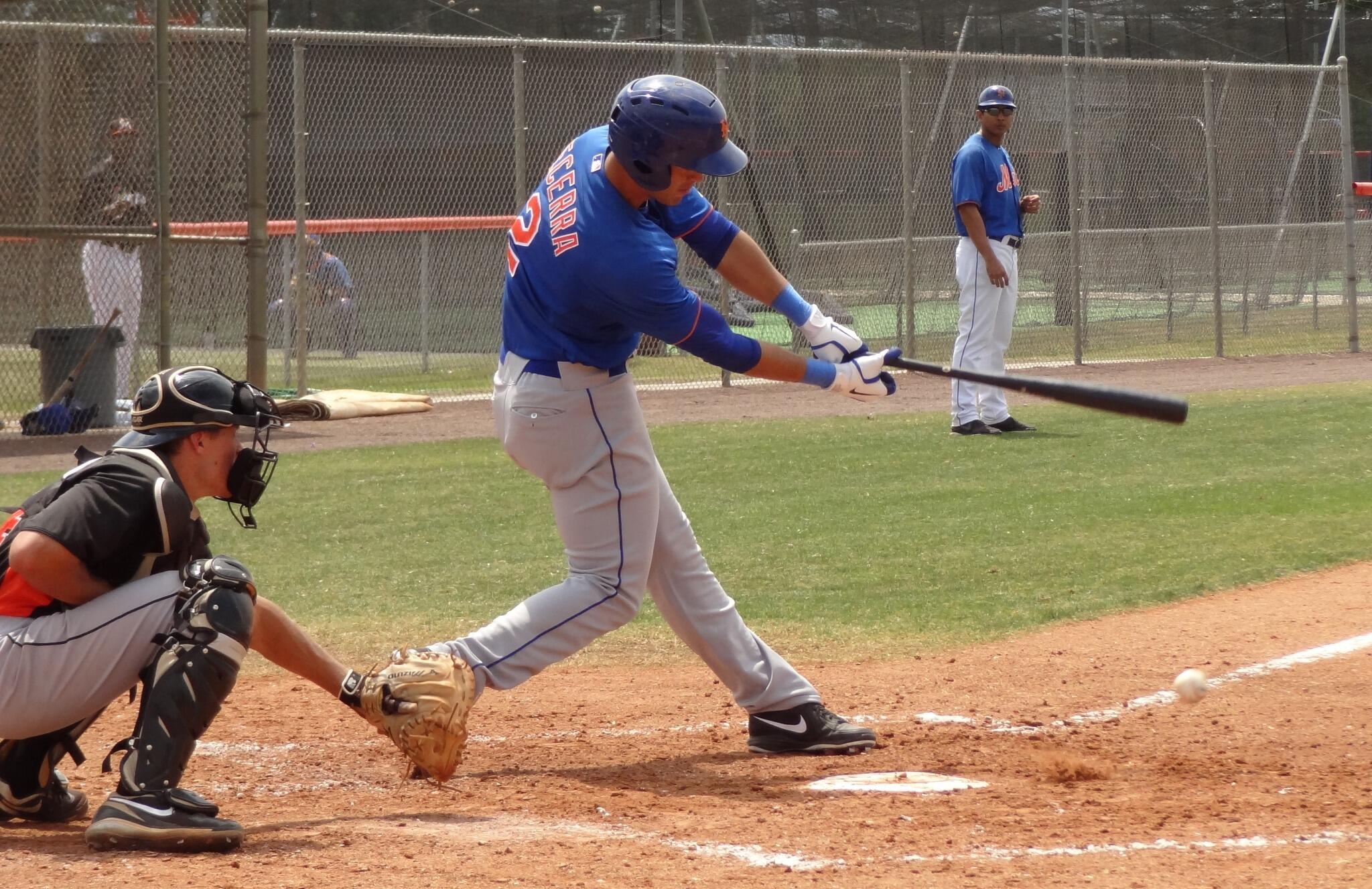
- Wuilmer Becerra, Mets (21): It’s hard to see how a team could keep Becerra on the big league roster all year, as he’s a still somewhat raw outfielder who played all year at low Class A Savannah. But Becerra, the Mets’ No. 10 prospect, has a chance for five average tools with a chance for above-average power.
- Jeffrey Baez Cubs (22): Baez’s raw approach is simply not ready for the big leagues in any way. But he’s got some power to go with plus speed. He is above-average defensively in left or right field and can play center field in a pinch.
- Jabari Blash, Mariners (26): Blash was left unprotected and unpicked last year, but the Mariners are taking a risk by leaving the toolsy outfielder available this year. Blash hit .271/.370/.576 with 32 home runs between Double-A and Triple-A this year. Blash doesn’t run as well as he did a few years ago, but he has prototypical right field tools and now he has upper-level minor league production as well.
- Jake Cave, Yankees (23): Cave is more of a well-rounded outfielder than toolsy, but he’s a lefthanded hitting center fielder who could entice a team looking for an inexpensive fourth outfielder. He runs well and has gap power but has lacked the selectivity to produce enough to get protected.
- Tyler Goeddel, Rays (23): Goeddel’s bat seemed to take off somewhat this year after he moved from third base to the outfield. He’s an athletic, if a little slight-framed righthanded hitter with a smooth swing who is above-average in the corners and playable in center field. Coming off a .279/.350/.433 season at Double-A, Goeddel is one of the more polished hitters available in this year’s Rule 5 draft.
Utility Infielders
- T.J. Rivera, 2b, Mets (27): He’s not a particularly sexy pick but Rivera always hits. He has hit .338 combined over the past two years at Double-A Binghamton and Triple-A Las Vegas and he has a career .318 batting average. Combine that with defensive versatility—he’s stretched at shortstop but he can play anywhere in the infield—he’s worth looking at as a potentially inexpensive utility infielder.
- Ronny Rodriguez, 2b/3b, Indians (23): An athletic infielder who slugged .491 last year in his third stint at Double-A Akron despite missing time with a broken hamate, Rodriguez was a shortstop who moved to second in deference to Francisco Lindor. He still gets over to shortstop on a sporadic basis, but he’s much more suited to playing second, third and even a little first base.
- Eric Stamets, ss, Indians (24): If you know what you’re getting, Stamets could be a smart pick for a team lacking in upper-level shortstop talent. Stamets is an above-average shortstop defensively. But the team picking him would also have to accept that he’s unlikely to hit at all.
- Jacob Wilson, 2b/3b, Cardinals (25): A righthanded hitter with significant power for a middle infielder, Wilson has some defensive versatility as he’s an above-average defender at second and third base with an above-average arm. He can play a little bit of outfield as well, adding to his versatility. He did struggle to make contact this past season, but that power could get him picked.
Hard-Throwing Relievers With Control Trouble
- Jose Adames, rhp, Marlins (22): Adames is coming off a middling year as a starter at high Class A Jupiter but his stuff (a 94-98 mph fastball and plus changeup) give him projection as a reliever, even if his control (4 BB/9) causes concern.
- Austin Adams, rhp, Angels (24): It’s very easy to understand why the Angels left Adams unprotected, even if they had room to spare on the 40-man roster. Adams walked 47 batters in 54 innings this past season. That wasn’t an aberration as he’s walked nearly seven batters per nine innings during his career. But his combination of a 92-93 mph two-seamer, 94-97 mph four-seamer and an exceptional slider also means he misses bats. That plus stuff could still entice a team to take a chance.
- Rafael De Paula, rhp, Padres (24): De Paula has an excellent arm with a mid-90s fastball and a potentially above-average changeup but an inconsistent slider. He was in over his head as a starter but he was much better after a move to the bullpen with a 34-10 strikeout-to-walk ratio in 26 innings after the switch.
- Onelki Garcia, lhp, White Sox (26): Garcia briefly made it to the majors with the Dodgers before they lost him to Chicago in a waiver claim. Garcia pairs a mid-90s fastball with an inconsistent slider. His lack of control has caused issues for him but he misses bats.
- Kaleb Fleck, rhp, Diamondbacks (26): A non-drafted free agent the Diamondbacks swiped after he went undrafted as a junior because he was recovering from Tommy John surgery, Fleck’s fastball has taken off as a pro. He mixes a plus fastball and an average slider, which explains how he’s struck out 11 per nine in each of the past two seasons. Fleck’s control numbers look a little shaky when you look at his walk rate, but he generally is an excellent strike thrower (65 percent strikes in 2015). Away from Reno, Fleck had a 1.16 ERA last season and he was especially tough on righthanders (.215/.285/.278).
- Reymin Guduan, lhp, Astros (23): Armed with a fastball that can touch 100 mph, Guduan is one of the safer bets in this year’s Rule 5 draft to be picked as he’s one of the 10 hardest-throwing lefthanders in the world. Guduan’s fastball/slider combo gives him the building blocks to be an excellent reliever one day, but he has significant control troubles that became more apparent as he climbed the minor league ladder and faced tougher hitters and smaller strike zones.
- Kris Hall, rhp, Athletics (24): Throughout his career Hall has piled up strikeouts thanks to his mid-90s fastball and an above-average breaking ball. He’s coming off his best year as a pro (5-0, 2.50 in 72 innings with Double-A Midland) and he was tough on righthanders (.185/.314/.269 in Double-A). But Hall has always had well below-average control (6.1 BB/9 for his career) and it has gotten no better.
- Zack Jones, rhp, Twins (25): Jones is yet another two-pitch reliever with a 94-98 mph fastball and a plus slider (at its best). Jones’ control is iffy, but his stuff is, like many pitchers in this category, excellent.
- Parker Markel, rhp, Rays (25): Markel has two potentially above-average pitches (94-97 mph fastball and slider) but his control troubles have always gotten in the way. His walk rate has gone up to 4.7 BB/9 IP since he reached Double-A.
- Matt Milroy, rhp, Marlins (25): See Milroy on the right night and it’s easy to project him as being able to help a big league club right now. When he’s repeating his release point and staying on top of his slider he can show a plus fastball and a plus slider. He struck out 33 and walked seven in 22 innings in June and July. But when his release point wanders, his control falls apart and he struggles to get out Class A hitters.
- Felix Pena, rhp, Cubs (25): A starter at Double-A Tennessee this year, Pena can touch 95-96 mph with his four-seam fastball as a starter and gets ground balls with a two-seam fastball that good depth. His breaking ball has improved as well. He struck out 140 batters in 130 innings this year as a starter (9.72 K/9). Pena has fringe-average control as a starter. If picked in the Rule 5 draft, Pena could move into the bullpen where his fastball should gain even a further tick.
- Sam Selman, lhp, Royals (25): Going back to his days at Vanderbilt, Selman has always had a great arm and inconsistent control. A full-time move to the bullpen hasn’t helped fix that issue. Selman held lefthanded hitters to a .211 batting average this year, but it’s hard to project him as a reliable lefty reliever when he allowed a .400 on-base percentage to those same lefties because he allows so many walks. Selman still has an excellent arm but he’s never stitched together three straight months of even fringe-average control.
- Peter Tago, rhp, White Sox (23): A minor league Rule 5 pick last year, Tago responded with a some of the best work of his career. Tago has a mid-90s fastball and a solid breaking ball but struggles to throw strikes.
- Alberto Tirado, rhp, Phillies (20): Tirado qualifies for two categories: he’s a power arm with control troubles and an inexperienced pitcher with a great arm. Acquired in the Ben Revere trade at the deadline, Tirado has an outstanding arm. He’s touched 100 mph at his best and can sit in the high 90s as a reliever. But he also has extreme control problems–he walked more than 10 batters per nine innings in his 16 innings with the Phillies high A Club, even though he also had a sparkling 0.56 ERA.
Solid But Unspectacular Stuff
- Dakota Bacus, rhp, Nationals (24): Bacus has a two-pitch combo that serves him very well. He has a 91-94 mph fastball to go with an at times wipeout slider. Bacus has reached Triple-A despite a modest 6.65 strikeouts per 9 IP ratio.
- Matt Bowman, rhp, Mets (24): There’s not much to like about Bowman’s 5.53 ERA and his .321 average against. But Bowman has a long track record of success before last year. He throws strikes with four average or fringe-average offerings.
- Chris Devenski, rhp, Astros (25): Devenski has the coolest pitch in the Rule 5 draft, as he gets his strikeouts with what he calls his “changeup of death.” Devenski profiles as a spot starter, low-leverage reliever after a very solid season (7-4, 3.01) at Double-A Corpus Christi that he capped with a win in the Triple-A National Championship for Fresno.
- Myles Jaye, rhp, White Sox (23): Jaye succeeds by locating solid average stuff. He can run his fastball up to 94 mph at times, but he’ll also sit in the high 80s for other stretches. He mixes in an above-average changeup and a fringe-average slider, and he can throw all three for strikes. He’s coming off a 12-9, 3.29 season at Double-A Birmingham where he showed durability and generally kept the ball in the park.
- Luis Lugo, lhp, Indians (21): A 6-foot-5 lefthander with four pitches that project as potentially average or better, Lugo has plenty of feel for setting up hitters. What he doesn’t have is the experience to succeed if he was pushed to the big leagues by a Rule 5 selection. Lugo survived (8-10, 4.45) in the Carolina League this year, but the Indians are taking only a modest risk by leaving him unprotected.
- Richard Rodriguez, rhp, Orioles (25): There’s nothing sexy with Rodriguez, but he has a solid-average 90-93 mph fastball and curveball to go with some deception. More importantly, Rodriguez has a solid track record of success. He was solid in three stops last year and has Triple-A experience each of the past two seasons.
Sluggers
- Zach Borenstein, of, Diamondbacks (25): Borenstein is a corner outfielder who hit .314/.394/.511 for Double-A Mobile, doing almost all of his damage against righthanders. Borenstein has a track record of hitting (a .499 career slugging percentage) and he cut his strikeout percentage significantly this year. He’s stretched in right field but is an average defender in left.
- Balbino Fuenmayor, 1b, Royals (26): Fuenmayor has plus to plus-plus power potential and he’s hit for average despite a swing-at-everything approach. He’s limited to first base defensively and fits best in the American League where he could also DH. Fuenmayor’s injury will make it a little tougher for him to earn a job in spring training, but some team could take a chance on acquiring some significant power cheaply.
- Ronald Guzman, 1b, Rangers (21): Signed for $3.45 million in 2011, Guzman still has loud tools, but a team picking him is going to have to be well aware that Guzman lacks the present skills help a big league club right now. Guzman is limited to first base only, and while he has power potential, it’s yet to show up in games. However, he hit .283 while reaching high Class A in 2015 and had 47 extra-base hits.
Lefty Specialists
- Daniel Stumpf, lhp, Royals (24): In 2013, teams spent a lot of effort trying to find lefty matchup relievers who could fill that niche role. Neither Patrick Schuster and Brian Moran ended up sticking with the teams that picked them. But a team looking for a similar lefty specialist might take a chance on Stumpf. Stumpf’s low 90s fastball and slider are excellent against lefties–he held them to a .151/.272/.236 average (16-for-126 with 17 BB and 40 Ks) in 2015. He struggles much more against righthanders and his control is at times shaky, but he could fit a team looking for a lefty specialist.